Using AI to Improve Debt Collection Strategies
See how AI and conversational AI strengthen debt collection strategies by optimizing outreach, boosting response rates, and improving customer experience

AI in Debt Collection Is a Game Changer
The pandemic changed many things, particularly in the realm of payments. During that period, people did not spend as much, some received supplemental income, and as a result, repayment rates reached unprecedented levels. One client even referred to this phenomenon as the “Great American Payoff,” with high risk segments paying off debts at unprecedented rates.
As the pandemic subsided and things began returning to normal, we observed the effects of inflation and other economic pressures. Many professionals report increased pressure in loss mitigation and higher losses. At FICO® World 25, Richard Pohlmann and I reviewed current economic conditions and explored how AI can help debt collectors work more efficiently, and support borrowers to remain current on their accounts with timely messaging and easy self-service payments.
Key Takeaways
- Financial strain is rising, making smarter collection strategies essential. From 2023 to 2024, 18% of U.S. credit card consumers began paying only the minimum, while missed payments increased across the board. This growing pressure makes AI-driven collection strategies critical for protecting recovery and managing loss.
- Customer experience now carries as much weight as the product itself. FICO survey found that 88% of consumers value their experience with a financial institution as highly as its products, yet only 28% feel that experience is a good one. Timely, personalized communication is the clearest path to closing that gap.
- Omni-channel outreach outperforms single-channel collection efforts. With phone-only right-party contact rates rarely exceeding 8 to 10%, integrating and sequencing SMS, voice, email, and push notifications significantly increase customer reach and prompts faster responses.
- AI strengthens collections across four core areas. By powering account segmentation, contact optimization, conversational communications, and hyper-personalized engagement, AI helps institutions reach the right customer, at the right time, on the right channel, with the right message.
- Conversational AI drives higher containment and measurable business outcomes. By automating payment arrangements and hardship scenarios, conversational AI increases containment rates, boosts self-service, and frees agents to focus on complex cases, delivering value for both customers and institutions.
How the Pandemic Changed Payments and Debt Collection
Let us first discuss recent economic trends. Notably, balances have recently been a bit lower, but the number of accounts missing a payment has increased. Average monthly credit card balances are slightly down, possibly due to reduced usage and less underwriting activity.
Minimum Payments and Missed Payments Are Rising
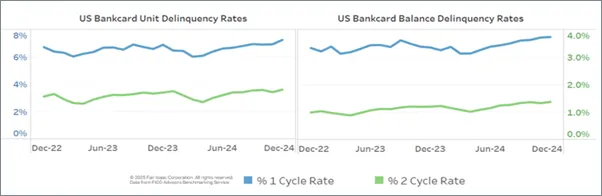
More concerning is the considerable increase in customers making only minimum payments. Data from 2023 to 2024, covering 130 million U.S. consumers particularly those with credit cards reveals two clear warning signs:
- 18% now pay only the minimum. Previously, about half of this population paid either their balance in full or more than the monthly payment but now the trend is toward the minimum, which may indicate growing financial strain.
- Missed payments are climbing. Customers missing one payment rose 5.3%, and those missing two payments rose 6.3%
From my experience in loss prevention, when the number of customers missing two or more payments rises, it signals increased stress and the need to reassess underwriting practices, client outreach, and the strategies used to help customers keep their accounts current.
Turning to customer experience, FICO's 2024 customer experience survey found that 88% of respondents consider their experience with a financial institution just as important as the products themselves. However, only 28% feel they are actually having a good experience. Many attribute this gap to disconnected or non-timely communication, creating a disjointed feeling when interacting with financial institutions. Customers cite clear, timely communication and easy self-service options as top priorities.
Omni-Channel Communications in Debt Collection Strategies
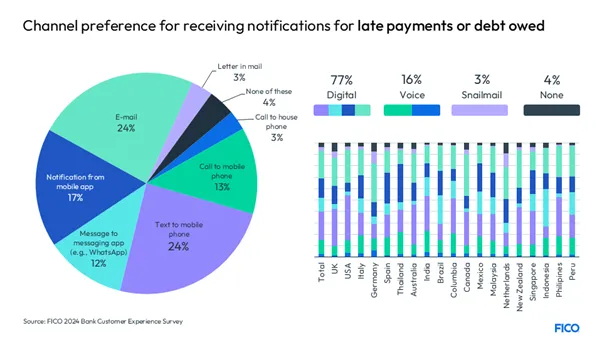
When it comes to communication channels, traditional methods such as phone calls are becoming less effective, with current right-party contact rates rarely exceeding 8–10%. Customer channel preferences are shifting toward more immediate, visible options:
- Text and push notifications: Most customers now prefer to be contacted by text message or push notification for debt or payment reminders, as these methods are more immediate and visible.
- Email: While still relevant in an omnichannel strategy, is less effective when used alone due to inbox overload however, when coupled with SMS, Voice and push notifications it can be part of an intelligent communication strategy to enhance consumer trust and self-service action.
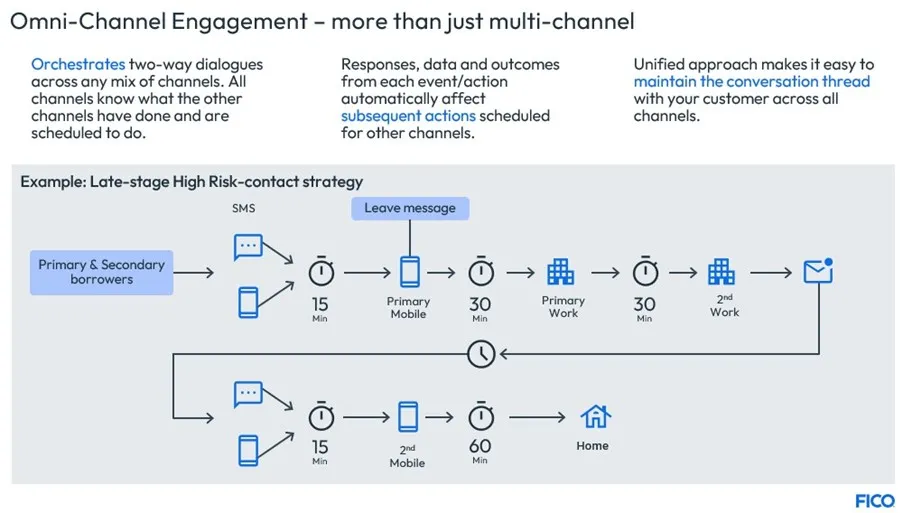
A true omnichannel approach—using multiple, integrated communication channels—is now the best way to ensure that customers are notified of issues and given opportunities to resolve them. Rather than using siloed channels (e.g., dialers, texts, emails, push notifications operating independently), integrating these channels and sequencing them within the same day significantly increases the chances of reaching the customer and prompts quicker responses.
Intelligent, data-driven communications also help identify customer preferences. If a customer responds to a text or IVR call, that information is used to shape future outreach. Sometimes, simply asking for a customer’s preferred channel is the most straightforward way to capture this data. The goal is to reach the right customer at the right time, with the right message, using interoperable channels and personalized messaging strategies.
Using AI to Improve Debt Collection Strategies
AI technology provides several ways to improve on debt collection communication strategies and results.
AI in Debt Collection Use Cases
- Segmentation of Accounts: AI can analyze vast amounts of customer data—including communication history and payment behavior—to group similar accounts and personalize outreach.
- Optimization: AI can help reach business goals such as increasing response rates or collecting more payments by finding the best channel and time to contact each customer.
- Communications: Natural language processing (NLP) powers conversational AI and large language models, enabling advanced self-service experiences where customers can interact naturally with virtual agents.
- Engagement: AI customizes messages from approved templates or generates personalized communications on the fly—enables hyper-personalized engagement across all touchpoints.
Let’s drill into the communication example.
Optimizing Outcomes by Using AI in Debt Collection Strategies
AI offers new ways to engage with customers in the debt collection process. It provides better options for treating customers with respect and empowers them through self-service tools to resolve debt situations independently.
To illustrate the impact, consider a scenario where a financial institution uses AI to analyze its customer data. It might be discovered that one customer prefers voice calls in the afternoon and is more likely to respond at midday. By leveraging this insight, the institution can schedule communications at optimal times and through preferred channels, increasing the odds of a timely response.
The benefits of this approach are twofold
- Moving customers from the “late responder” cohort to the “early responder” group saves costs and avoids over-communication, resulting in a better customer experience.
- Increasing overall response rates leads to higher self-service and improved outcomes for both customers and the institution. In some cases, this approach can even help identify customers at risk of delinquency before they miss a payment, enabling proactive outreach and support.
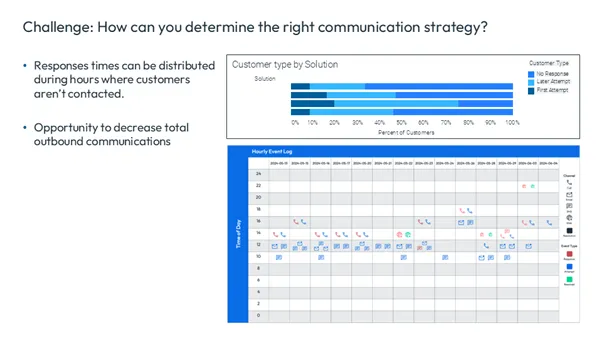
AI-driven intelligent communication strategies can be built to optimize various outcomes. Models can use payment and cost data to maximize payments collected while limiting dollars spent. It can also look at communication data to optimize responses, enabling more customers to self-service.
Conversational AI, specifically, is revolutionizing collection communication strategies by enabling out-of-the-box chatbots that financial institutions can rapidly deploy and customize. These chatbots can handle payment arrangements, hardship scenarios, and other common interactions—automating what once required a live agent.
The path to hyper-personalization in collection strategies involves combining AI-driven decisioning (best time and channel), conversational AI (for handling responses and self-service), and dynamic content generation. This trio of technologies enables personalized and seamless engagement throughout the delinquency lifecycle.
The Time for AI in Debt Collection Strategies Is Now
While AI is a popular buzzword, its true value lies in driving measurable business outcomes: increasing containment rates (the percentage of customers who resolve issues without needing an agent), boosting response and resolution rates, and creating positive customer experiences. Containment rates are a crucial metric—indicating how many customers can resolve their situation independently, freeing up agents to focus on more complex cases.
Modern tools empower customers to resolve debts independently while enabling institutions to optimize collections strategies and resource allocation. With the right approach, conversational AI can deliver positive outcomes for both customers and businesses.
How FICO Can Help You Improve Debt Collection Strategies
- Watch our FICO World presentation Collections: Delivering Superior Customer Journeys with Conversational AI and Enhanced Self-Service, to learn more about FICO’s ever-evolving omni-channel engagement capabilities
- Download our whitepaper, Unlocking the Power of Collections and Recovery Analytics, to discover how prescriptive analytics can strengthen your debt collection strategies improving collection and recovery performance by as much as 30%, reducing write-offs and losses and helping one organization save $5 million a year in write-offs.
- Read the Hot Topic Q&A, New Frontiers in the Collections Industry, to discover how an omni-channel approach transforms debt collection strategies and learn the five success drivers of omni-channel communication: customer experience, operating expenses, compliance and risk, collection success, and employee satisfaction
- Learn how FICO® Platform powers debt collection strategies that are digital-first, outcome-focused, and compliant, and see how Westpac New Zealand achieved a 25% increase in digital engagement, a 40% cost reduction, and 10% higher customer rehabilitation rates. Read the whitepaper.
- Explore an automated collections strategy for telecommunications that transforms collections from a cost center into a strategic advantage through four critical applications to separate recoverable debt from fraudulent cases
Frequently Asked Questions
Return on investment typically materializes across three dimensions: improved recovery and response rates, reduced cost-to-collect through automation and self-service, and lower write-offs enabled by earlier, more precisely targeted intervention. Institutions can quantify this value by benchmarking resolution rate, containment rate, and cost-to-collect prior to and following deployment, then monitoring reductions in roll rates and charge-offs over time.
Collections remains a highly regulated discipline, and automation does not diminish that responsibility. A well-designed omni-channel approach can, in fact, strengthen compliance by centralizing engagement rules across all channels, capturing and tracking customer consent, and maintaining a comprehensive audit trail of contact timing, frequency, tone, and customer response. Because requirements vary by jurisdiction and product, engagement strategies should be configured in consultation with legal and compliance teams.
Recovery rate represents only one dimension of performance. A comprehensive assessment should encompass containment rate, response and resolution rates, cost-to-collect, roll-rate reduction, and customer-experience indicators such as complaint volume and self-service adoption. Within a fully integrated omni-channel environment, connected channels additionally enable measurement of payments completed within a defined window relative to each outreach.
AI and advanced analytics evaluate payment history, behavioral signals, and communication responses to segment accounts with greater precision than manual review permits. This enables organizations to identify customers experiencing genuine hardship, who may benefit from flexible and empathetic arrangements, while flagging patterns associated with intentional non-payment for closer examination, thereby improving both fairness to customers and the efficient allocation of recovery resources.
As automation assumes responsibility for routine reminders and straightforward self-service interactions, the cases escalated to live agents tend to be more complex and consultation-intensive, frequently involving hardship or exceptions. This transition shifts agents toward higher-value work requiring empathy and judgment, and presents an opportunity to upskill staff. Clearly communicating the rationale, namely customer demand for self-service, operational efficiency, and more meaningful work, supports successful adoption.

Popular Posts

Has the Reporting of Rental Data to the Credit Reporting Agencies (CRAs) Increased?
FICO Score 10T includes rental data, but consumers can only experience the benefit of this to the extent that their rental data is reported to the CRAs
Read more
Average U.S. FICO® Score at 716, Indicating Improvement in Consumer Credit Behaviors Despite Pandemic
The FICO Score is a broad-based, independent standard measure of credit risk
Read more
Average U.S. FICO Score at 711, But Uncertainty Abounds
It generally takes some time for the effects of a major macroeconomic event to start to show up in consumers’ credit reports.
Read moreTake the next step
Connect with FICO for answers to all your product and solution questions. Interested in becoming a business partner? Contact us to learn more. We look forward to hearing from you.